
America 250 Travel Ideas: Revolutionary War Sites & Historic Places to Visit in New England
- Greg Thompson
- 2 days ago
- 9 min read

Updated: 7 hours ago
The Northeast doesn’t just teach the American Revolution; you can still walk inside its weather.

In New England, the past isn’t sealed behind velvet ropes. It’s embedded in brickwork and harbor wind. It’s the creak of old floorboards in a meetinghouse, the sudden quiet of a burying ground tucked behind a downtown coffee shop, the long, sloping green where a line of ordinary people once decided they would no longer be ordinary subjects. As the United States approaches the Semiquincentennial, America’s 250th in 2026, there’s a particular kind of travel that feels less like “vacation” and more like pilgrimage: not to a single shrine, but to a chain of places that still hold the heat of argument.

America250 is framed as a multi-year invitation—an opportunity to reflect on the nation’s past, honor contributions across communities, and imagine what “a more perfect union” might require from us now. That’s the right tone for New England travel, because the Revolution here is not a neat story of heroes in tricorn hats. It’s a landscape of competing ideals, exclusions, hypocrisies, courage, fear, and reinvention—sometimes all in the same street.
So consider this your narrative itinerary: a week (or two) moving through Massachusetts, Rhode Island, Connecticut, New Hampshire, Maine—and, if you’re willing to widen the arc just slightly, the northern corridor that ties New England to the Revolution’s decisive turning points in New York and the Lake Champlain region. You can do it as a road trip, a rail-and-rentals hybrid, or a series of long weekends. The goal isn’t to “see everything.” The goal is to feel the chain reaction—how local choices became continental consequences.

Get additional travel details from Frommer's Guides.
Note: We are an Amazon Affiliate and your purchases through our links fund our projects and are greatly appreciated.
America 250 - Boston: start where arguments still echo
Begin in Boston, not because it’s the most “important,” but because it’s the most layered. The city is a palimpsest: Revolutionary Boston sits under abolitionist Boston sits under immigrant Boston sits under tech Boston, and the seams are visible if you walk slowly enough.
The Freedom Trail is your opening chapter. It’s 2.5 miles connecting sixteen nationally significant sites, compact enough to do in a day, dense enough to justify two. You don’t need to treat it like a checklist. Treat it like a narrative spine: you’re moving from civic space to worship space to commerce to conflict to waterfront, watching the Revolution take shape as a lived urban drama.

And here’s the first “America 250” lens to keep in your pocket: the Revolution was never just a battlefield story. It was a struggle over public life, who belonged in the “we,” who had a voice, whose labor made the city run, and who paid the costs.
That’s why, alongside the standard Freedom Trail stops, you should deliberately braid in Boston’s Black history. The National Park Service’s Boston African American National Historic Site points you to Beacon Hill and the Black Heritage Trail, a reminder that freedom talk in Boston eventually collided with the reality of slavery, racism, and unequal citizenship. When you stand in those streets, you’re not just “adding diversity.” You’re confronting the truth that American ideals have always been contested—expanded by people who were often denied them.
Boston National Historical Park is a useful hub for this kind of layered travel, because it anchors multiple stories (including the Freedom Trail experience) and offers ways to hear the city with guidance rather than noise.
Travel note: If you can, begin early—pre-tourist Boston. The city feels more like itself before the day turns into a funnel. You’ll hear how close the streets are, how quickly a crowd could gather, how public speech could become public pressure.
Lexington and Concord: where “beginning” becomes real
From Boston, move west—not far, but psychologically far—into the towns that hold the Revolution’s ignition story.
Minute Man National Historical Park preserves and interprets the opening battles of April 19, 1775 across Lexington, Lincoln, and Concord. This is where the mythic phrase “the shot heard round the world” becomes physical geography: roads, fields, river crossings, angles of fire, lines of retreat. The park explicitly frames the Revolution’s 250th as a moment for reflection on shared history, governance, and human rights—exactly the kind of interpretive posture that makes a Semiquincentennial trip feel alive rather than ceremonial.
There’s also something quietly powerful about the way archaeology keeps interrupting our certainty. Minute Man has highlighted discoveries like musket balls connected to the fighting at Concord’s North Bridge—small artifacts that pull the war down from marble and back into hands and fear.
If you want a local “America 250” experience that’s not just observation but participation, look at Concord’s community-based commemorations—projects that treat remembrance as something you make together, not just consume.
How to walk it: Don’t rush Battle Road. The temptation is to treat the park as “a site.” It’s better as a sequence. Let the distance teach you something: the Revolution began as movement—rides, alarms, mobilizations, retreats, regroupings.
Salem: the Revolution seen from the waterline
Now pivot to a different Revolutionary truth: independence was also about trade, empire, and the ocean.
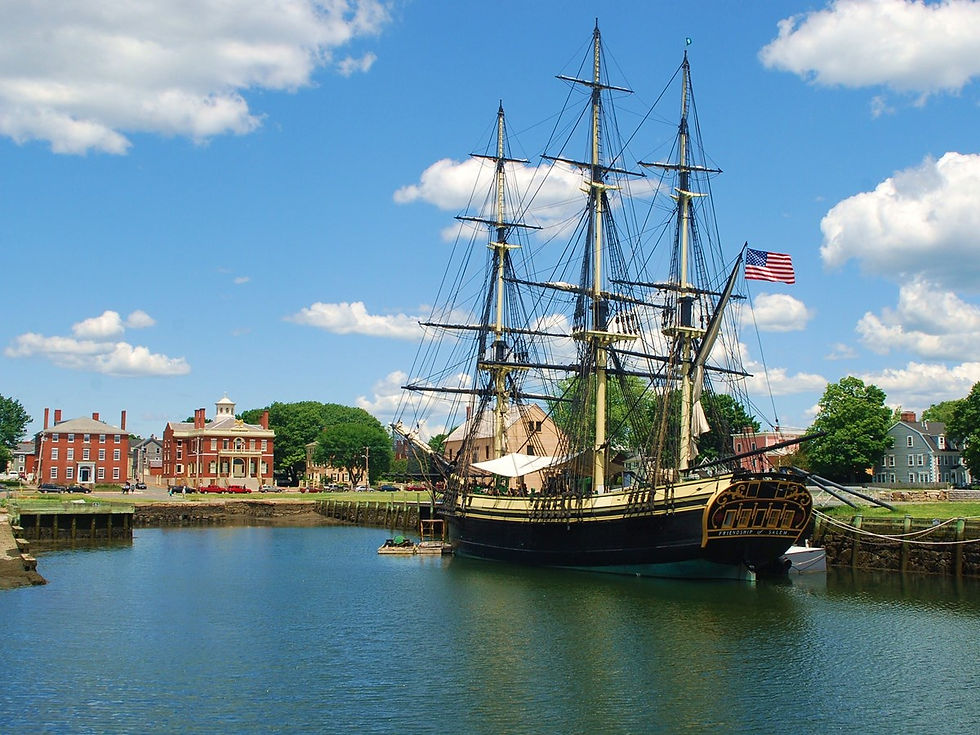
Salem Maritime is a place where New England stops feeling like a set of quaint towns and starts feeling like a node in global systems; shipping, privateering, customs enforcement, wartime supply. The National Park Service notes that Salem Maritime was established in 1938 as the first National Historic Site in the United States, and it interprets “New England roots, global connections” along the waterfront.
This matters for America 250 travel because the Revolution wasn’t merely a protest against taxes; it was a reordering of who controlled trade routes, whose ships moved freely, and whose labor was exploited to make that movement profitable. Standing by the harbor, you can feel the Revolution’s economic stakes in a way that battlefields alone can’t provide.
Pair it with: a slow afternoon in Salem that is not only witch-trial tourism. Look for the maritime story, the working waterfront story, the “how did goods—and power—move?” story.
Portsmouth, New Hampshire: a smaller city, a sharper edge
Head north into New Hampshire and give yourself a day in Portsmouth. If Boston is a chorus, Portsmouth can feel like a solo—smaller scale, crisp detail. This is where local sites and museums shine because the Revolution was never only a capital-city phenomenon. It was arguments in taverns, militias forming in counties, ships in harbors, and communities deciding what risks they were willing to take.
In Portsmouth, you can stitch together:
Historic neighborhoods and preserved houses that show what political upheaval looked like in daily life (who had rooms, who served, who owned, who rented).
Local museums that frame the port as an Atlantic world outpost.
Fort and harbor sites that explain why seacoast defense mattered when “independence” was still hypothetical.
This is the New England lesson in miniature: the Revolution was both everywhere and uneven—felt differently depending on your class, your race, your job, your vulnerability.
Rhode Island: Newport and Providence as a study in contradiction
Rhode Island is an America 250 gift because it forces you to hold two truths at once:
Revolutionary ideals of liberty were loud here.
Wealth in this region was also deeply entangled with Atlantic slavery and trade.
That tension is not a footnote—it’s a core American theme. It’s exactly the kind of mature, reflective engagement the Semiquincentennial invites.
In Newport, visit:
Historic waterfront and colonial streetscapes that make you feel the port-city scale of the 18th century.
Local historic houses that show elite life—and invite you to ask: where did the money come from? who built this? who was excluded from its comfort?
In Providence, look for:
Museums and historical societies that interpret Rhode Island’s political culture, religious diversity, and commercial networks.
Walking tours that connect public squares to the quieter labor of archives and memory.
America 250 travel tip: When you take a mansion tour, balance it with a museum or site that centers the labor and the limits—otherwise you’ll accidentally reenact the old story: admiration without accountability.
Connecticut: Mystic, New London, and the coastline of consequence
Connecticut’s coastline is a reminder that the Revolution was fought not only on famous greens and hills but also through raids, shipbuilding, supply lines, and coastal vulnerability.
Mystic and nearby towns are ideal for:
Maritime museums that make naval life legible (ropes, sails, shipyards—skills and industries that made war possible).
Local historic sites that map how wartime disruption hit ordinary people.
New London and Groton, meanwhile, offer some of the most emotionally direct Revolutionary-era places in New England: forts, memorials, and the hard geography of invasion and retaliation. It’s where “independence” looks less like speeches and more like smoke.
Build a day around:
a fort site,
a museum stop,
and one quiet hour by the water to let it settle.
This is the point in the trip where many travelers notice something: the Revolution in New England is as much about fear as it is about idealism. Fear of losing property. Fear of punishment. Fear of being trapped on the wrong side of history.
Maine: the frontier edge of the Revolutionary story
Maine is essential to an America 250 journey because it breaks the tidy map. Here, the Revolution intersects with frontier life, Indigenous homelands, contested sovereignty, and a different scale of distance.
Maine’s Semiquincentennial framing explicitly calls the 250th “a once-in-a-generation opportunity” to share the whole history and strengthen the history field—language that signals the state is thinking beyond pageantry and toward public meaning.
In practice, your Maine leg can include:
Portland-area historic sites and museums that interpret wartime politics and Atlantic connections.
Smaller local historical societies (often volunteer-driven) that preserve community memory with surprising specificity—letters, ledgers, household objects, militia records.
Sites that push you to ask: What did the Revolution mean in places where the “nation” was still an idea but the land was already inhabited, named, and claimed?
Maine is also where you feel the physical truth of 18th-century travel: the Revolution’s world was bigger, slower, and harder than our commemorations sometimes admit. That’s worth experiencing in your body—longer drives, colder air, wider water.
Massachusetts 250 as a “thread” you can follow
If you want to travel with an organizing structure, Massachusetts makes it easy because the state’s 250 programming is explicitly designed to connect sites and stories across 2025 and 2026, highlighting battles and “untold and little-known stories.”
That phrase—untold and little-known—is the key. For your Semiquincentennial trip, don’t only do the “greatest hits.” Use the big sites as anchors, then chase the smaller local ones that make the Revolution feel like human life:
a town common with a modest marker,
a house museum staffed by one passionate docent,
a cemetery where familiar names suddenly feel unfamiliar,
a local archive exhibit that reminds you history is built from paper and patience.
Optional but powerful: the northern corridor that explains why the Revolution worked
If you can extend beyond New England proper (still very much “Northeast travel”), add a northern corridor loop that helps explain how the Revolution shifted from rebellion to real possibility.
Fort Ticonderoga (Lake Champlain region)
Fort Ticonderoga’s Semiquincentennial programming has been built around “real time” Revolutionary interpretation tied to the 250th—an immersive approach that can make the era feel startlingly present. Even if you’re not a reenactment person, the fort’s location teaches strategy: lakes, corridors, supply routes, and the geography of control.
Saratoga National Historical Park (New York)
Saratoga is where the Revolution begins to look winnable—a turning point that echoes far beyond the battlefield. The National Park Service preserves the landscape and offers ways to experience it as more than a monument.
This loop changes your whole trip: you start in Boston where protest becomes conflict, then you end with places that show how conflict becomes outcome.
How to travel the Semiquincentennial without turning it into theme-park history
A Semiquincentennial trip can go two ways.
It can become patriotic wallpaper—photo ops, souvenir flags, and a familiar script.
Or it can become something rarer: a travel practice of civic attention.
Here are a few ways to keep it real:
Ask better questions at every site.Not just “what happened here?” but “who wasn’t allowed to speak here?” “who cleaned this space?” “who financed this?” “who suffered for this?” The 250th is an invitation to widen the story, not shrink it.
Pair monuments with museums.Monuments tell you what a society wanted to remember. Museums (at their best) tell you what was complicated, contested, or inconvenient.
Let walking be part of the method.Walk the Freedom Trail not to finish it, but to understand how ideas move through streets. Walk portions of Minute Man not to “see the sights,” but to feel distance, timing, vulnerability.
Collect “small evidence.”A ship’s rigging diagram. A musket ball display. A ledger page. These tiny things are the antidote to oversimplification.
The real souvenir: a changed map in your head
By the end of this journey, New England won’t feel like a corner of the country with charming old towns. It will feel like an engine room—where political imagination met practical organizing, where commerce and conscience collided, where liberty was declared and then contested for generations.
That’s what makes America 250 worth traveling for. Not the anniversary itself, but the chance to stand in places where people made choices without knowing the ending. The Semiquincentennial asks us to look back—and then to look around—and decide what we’re doing with the inheritance.
If you go, go with curiosity. Go with humility. Go ready to be surprised by how present the past still is—especially in the Northeast, where you can still follow the Revolution not as a myth, but as a trail of real ground under your feet.


Comments